How Many Crickets Do I Feed My Baby Savannah Monitor
The Savannah Monitor is i of the smallest and about popular species among the monitor genus.
They are popular because they are very friendly and are easier to continue than other larger monitors.
This does not mean they are suitable for beginners and they even so require avant-garde care.
Known to like insects and small mammals, they are an inactive pet and volition spend most of their time basking or lounging in their enclosure.
These African lizards need to live in big enclosures with high temperatures. If you are interested, read one below to discover out how to treat them…
Tabular array of Contents
- Savannah Monitor Overview
- What We Like Almost Savannah Monitors
- Species Appearance
- How Big Will a Savannah Monitor Go?
- Color Variations and Markings
- Savannah Monitor Enclosure
- Savannah Monitor Muzzle & Set Up
- Cleaning & Misting
- Savannah Monitor Intendance
- Savannah Monitor Diet
- Savannah Monitor Lifespan & Health
- Typical Behavior
- Are Savannah Monitors Friendly?
- Handling Advice and Tips
- Infant Savannah Monitor
- Buyer's Guide
- Savannah Monitor Facts
- Summary
Savannah Monitor Overview
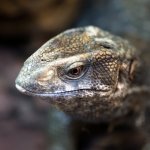

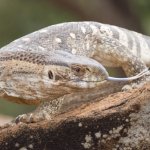
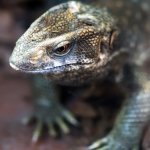
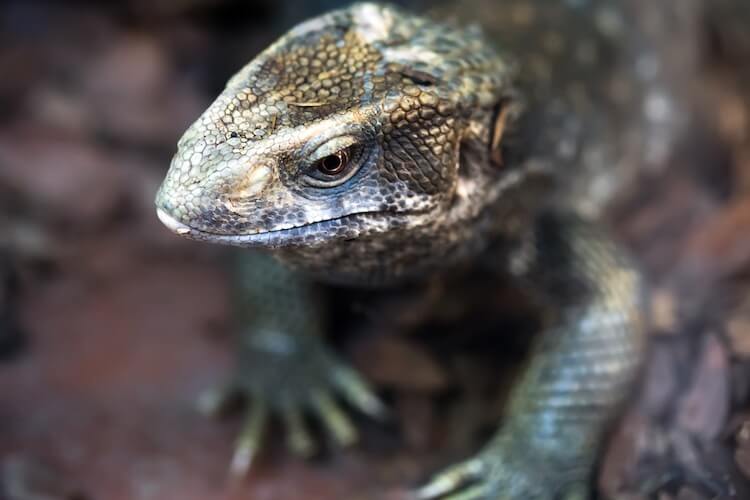
Savannah Monitors are naturally found in sub-Saharan Africa. Equally their name implies (savannah terrain), they like to alive amid the rocky desert and woodlands.
This species is used to the hot temperatures of sub-Saharan Africa. They naturally soak themselves in pools of water to keep cool.
Reptile owners love them because they accept a very docile nature when compared with larger monitor species.
Grayish-tan in appearance, they accept spots on their backs and rings on their brusk tails.
They consume a variety of invertebrates and small mice. In the wild, they hunt using their natural language to pick upward chemic cues from the environment they live in.
Alone lizards, they volition only collaborate with their own species during the convenance season. If you are planning to keep this reptile, it should be the only one you have in the enclosure.
Unfortunately, they are considered to be endangered by some organizations due to hunters seeking them out for their skin.
What Nosotros Similar About Savannah Monitors
Pros
- One of the friendlier monitor species, they make a groovy offset monitor.
- Relatively few health problems and are very hardy.
- Can survive in low humidity and accept depression husbandry requirements.
- They can grow up to three feet in length and weigh every bit much as 11 pounds. Grayish-tan in color, they have dorsal spots and rings on their tail.
Cons
- This species must be housed lonely. You cannot have more than one in an enclosure at once.
- They need a very big enclosure and their housing gear up-upward may be plush.
- Savannah Monitors are carnivorous; eating insects as well every bit the occasional rodent.
- They require extremely high temperatures in their basking spot.
Species Advent
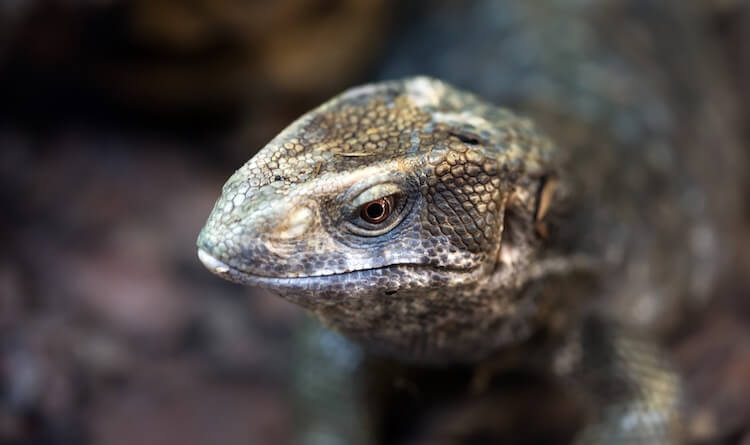
There are 5 subspecies of the Varanus exanthematicus, so their appearance and size will vary based on which species you purchase.
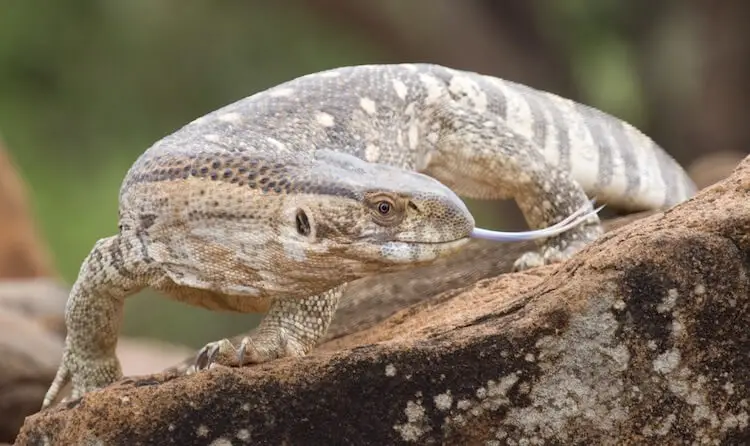
However, all Monitors have deeply forked tongues. This helps them option upwardly chemical signals from their environs.
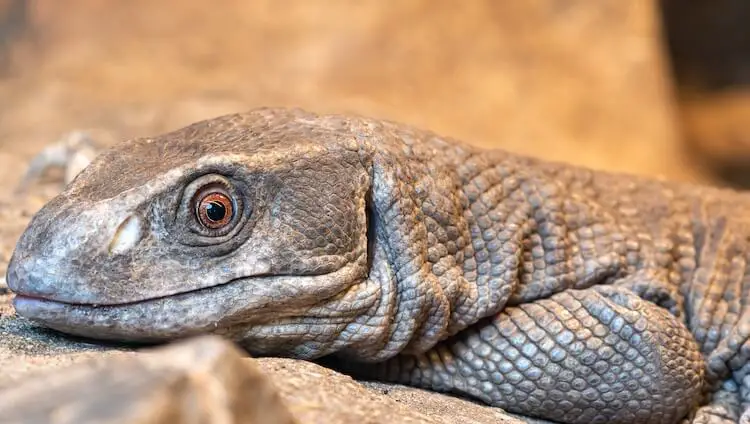
Their typical appearance is stocky and thick with a wide head.
They have a short neck and tail.
You may need to rely on a veterinarian or expert herpetologist to sex your lizard, because there is no true sexual dimorphism. This makes information technology very difficult to tell males and females apart.
How Large Volition a Savannah Monitor Get?
Total grown Savannah Monitor lizards are betwixt two to four anxiety in length by four years old. They tin can counterbalance as much equally xiii pounds.
At birth, Babies are merely a couple inches long, but they grow incredibly quickly.
Color Variations and Markings
This species has a grey-brown base color with accept night-edged xanthous spots on their dorsum. They have a blue tongue and xanthous and brown rings on their tail.
Savannah Monitor Enclosure
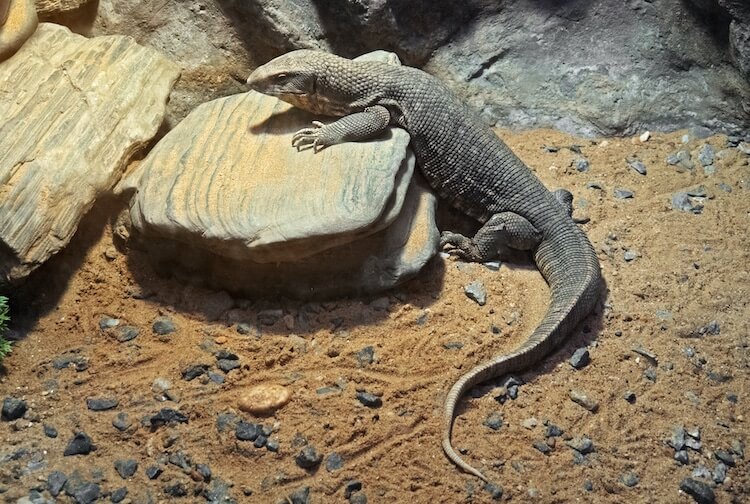
This lizard lives in a natural habitat of rocky deserts and forests in Africa's wild savannah.
They are relatively inactive in the wild. They will spend much of their time basking and soaking themselves and will likely display similar behaviors in their enclosures.
Because they similar to spend plenty of fourth dimension soaking and in the forest, their cage should have some logs, branches, rocks, and even cork bark slabs.
Any of these items will piece of work as long every bit they tin be easily cleaned or removed for cleaning.
Savannah Monitor Cage & Prepare
Although they are just considered a medium-sized monitor Savannahs are still a large reptile.
They need a large enclosure which should accept a space of about 5ft x 4ft ten 4ft – if not more than.
Their tank will likely need to exist custom made and should exist set for when y'all bring your lizard home.
Enclosures should be made of plexiglass or plastic.
The top of their enclosure should accept a screen to permit for airflow, whilst being secured to foreclose any escapes. These monitors are very strong and smart.
Babe Savannah Monitors should be kept in 50-gallon tanks. This tank will be big enough for their get-go half-dozen months.
They grow quickly so some reptile owners decide to put them direct into their developed enclosures:
- Tank Type: plastic or plexiglas cage.
- Tank Size: 5ft x 4ft ten 4ft minimum.
- Lighting: UVB and high wattage basking bulb required.
- Substrate: newspaper.
Active during the mean solar day, they require a UVB light for essential vitamin production, particularly for babies! Lighting should be on for nearly 12 hours of lite and 12 hours of darkness each mean solar day. Y'all should also use an incandescent bulb to create a very hot basking spot. Brand sure the incandescent low-cal is out of accomplish from your monitor.
In terms of temperature, the daytime gradient in the enclosure should exist 80℉-95℉.
A basking spot should exist even warmer, as high equally 120℉ is platonic.
Existence a desert-type cadger, Savannah Monitors are not as picky almost their humidity levels equally many other reptiles.
In their natural environment, it is very dry and arid. Because of this, the basking spot tin be kept at very low humidity. The rest of the tank should be kept at betwixt a 50 to lx% humidity.
The water-pool in your Savannah Monitor's enclosure should exist large plenty to soak in too.
Finally, considering monitors are messy, a suitable substrate would be something that can be cleaned easily! It volition need to be spot cleaned every day and thoroughly cleaned out at least one time a week.
Given that they will be in a large enclosure a substrate like paper will be the easiest to clean. Make sure not to utilize sand or gravel as this tin can crusade bowel obstruction, peculiarly in Juveniles.
You should also avert reptile carpet as it tin entangle and tear their large claws.
Cleaning & Misting
Equally a species, monitors are very messy and defecate frequently. They have a trend to defecate in their h2o, so exist certain to monitor it advisedly and immediately change it if information technology becomes dirty.
Their puddle of h2o should contribute to keeping the tank at mid-level humidity, and yous should not have to mist the tank. The best style to keep rail of this is to identify a humidity gauge on the cool side of the tank and only mist if the humidity falls below 40%.
Their enclosures must be cleaned oftentimes.
Feces should accept a normal solid brownish part and a solid white part too. If information technology is unusually colored or textured, this may be a sign of a health problem.
Carrion should be spot cleaned every day from their enclosure, peculiarly if information technology is in their water.
The unabridged tank should be thoroughly cleaned out every week or two.
This may crave removing substrate or various logs and branches and temporarily homing your monitor somewhere else.
Savannah Monitor Care
Savannah Monitor Nutrition
This Cadger eats a variety of invertebrates and small mammals in the wild. They are not picky about what they eat and may eat insects, mealworms, pocket-size mice, or even snails. Y'all can on occasion feed a mouse. They may also swallow thoroughly cooked pieces of beef, but ideally they should stick to mice and invertebrates.
A carnivorous reptile, they hunt and sense their environment by flicking their tongue to pick up chemical cues.
Nutrient should be dusted with a calcium supplement, and a multivitamin should be fed if you lot are not feeding mice to your monitor.
When you feed your monitor, place the food into the cage and so that they can provender for it. This keeps them more active:
- Adults should be fed several insects one-2 times a week (larger monitors may eat less often).
- Juveniles should be fed 2-iii times per calendar week.
- Babies should be fed every other twenty-four hour period.
Baby Savannah Monitors volition eat the same basic diet, annihilation from crickets and waxworm larva to pre-weaning mice.
Whatever alive nutrient, for adults or babies, should be removed at the stop of the twenty-four hour period if uneaten.
Finally, monitors should always have access to make clean water.
Their water bowl should be large enough for them to soak in; born containers or plastic pans piece of work slap-up.
Savannah Monitor Lifespan & Wellness
Savannah Monitors alive about 12 years in captivity but can live upwardly to xx years with good husbandry.
They usually have few health issues in captivity, specially if they are captive-bred.
Two distinct bug may occur with a poor nutrition:
- Metabolic bone disease can event from a lack of calcium and may cause your lizard to feel sluggish.
- Obesity tin can result from overfeeding your monitor. If your Lizard starts abnormally gaining weight, yous may need to restrict the corporeality of food they are consuming temporarily.
Wild-defenseless Monitors are prone to having parasites, which is one reason that you should larn this species through a breeder.
They enjoy soaking themselves, so you shouldn't need to bathe them.
Signs They Are Healthy
- Basking and soaking usually.
- Eager to eat.
- Clear and vivid eyes.
Sickness Symptoms
- Lethargic and sluggish.
- Sudden weight gain.
- Dragging their limbs or tail.
Typical Beliefs
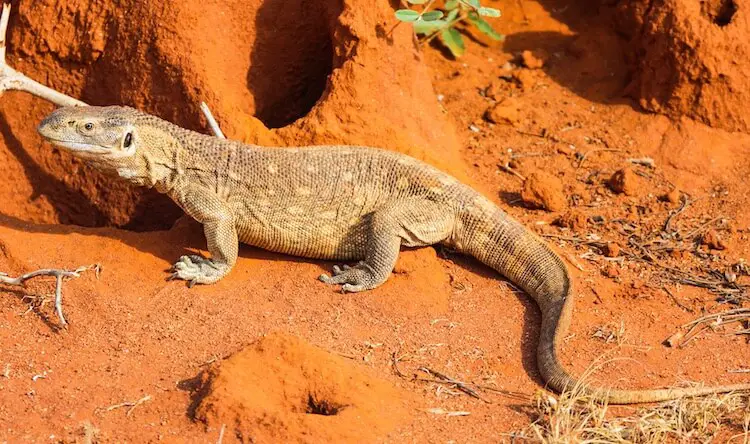
When not in captivity, the Savannah Monitor is a solitary reptile and will simply socialize with its own species during its breeding season.
Known for being very territorial, males will fight if they come into contact with one another.
They are non especially agile creatures and will spend time lounging in or out of the basking spot.
Virtually of their time will be spent basking and occasionally foraging for food, they exercise this with tongue flicking. Tongue flicking in captivity may indicate that your monitor is hungry or just being curious.
They only communicate with each other through pheromones and other chemical signals which they notice with their tongue.
Mating and fighting volition show dissimilar forms of communication.
To ward off predators, they might hiss loudly and thrash their tail, or it may play dead as a last resort.
These creatures must exist housed lonely due to their territorial behavior towards other lizards.
Are Savannah Monitors Friendly?
Yes, especially as far as monitors go. They are a very friendly species and tin can be taught to tolerate handling over a period of time.
They are generally ane of the less nervous monitor species and then get along well with their owners.
However, they are strong lizards and require a stiff grip.
Once tame they may not show aggression to you.
A wild developed can evangelize a strong bite or nasty scratch information technology non socialized properly.
Handling Communication and Tips
The Savannah Monitor is 1 of the most docile species amidst the monitor genus. All the same, this does not mean they tame hands.
Monitors crave a lot of patience and work from their keeper to to exist well-socialized.
Safe handling requires lots of face fourth dimension and repetitive handling.
Information technology is a commonly known fact that well-nigh reptiles carry Salmonella bacteria. Washing your hands earlier and after handling is good for your health and can prevent infections.
Another trouble owners may find during handling are scratches from their cadger's nails.
The best style to handle your monitor is to place a business firm grip backside the reptile'south head and put ane paw near the hind limbs.
Babe Savannah Monitor
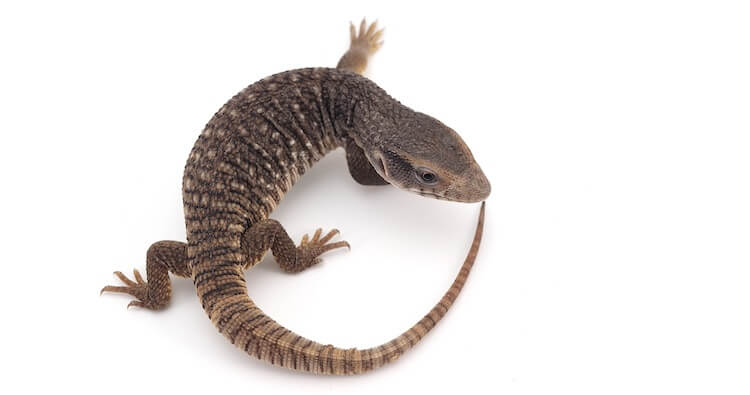
The breeding season occurs during the wet season (i.east. May). A male will follow a female person and will periodically seize with teeth and scratch her neck until she allows copulation.
Females need a nest box to lay eggs. In the wild, she would usually make her own or lay them in a termite mound. For your monitor, a suitable nest box tin exist a plastic tub filled with soil.
After she lays her eggs, they should be incubated in groups in a ten-gallon aquarium filled with vermiculite and water.
There is a v-6 month incubation time, and the container should be opened occasionally to let oxygen in. They should exist incubated at 82℉, and the temperature and moisture should be monitored carefully.
In that location are usually 20-50 eggs per clutch.
Hatchlings are a couple inches long at birth.
They volition start eating insects and other invertebrates a week later hatching. They volition demand to exist feed near every day at the start and and then less often as they age (see diet guide above).
Buyer's Guide
Savannah Monitors are one of the more readily bachelor monitors and cost virtually $50 to $100 USD.
Information technology is strongly recommended that you obtain your Lizard from a trusted breeder, rather than somewhere where they are wild-caught.
Wild-caught monitors are highly decumbent to having parasites and are often stressed when forced to arrange to a captive lifestyle. Breeding them in captivity tin can exist hard, then while finding a convict-bred monitor may prove to be more of a challenge, information technology is worth the effort for your experience and the species' protection.
Savannah Monitor Facts
| Vital Facts | |
|---|---|
| Mutual Name | Savannah Monitor |
| Scientific Proper name | Varanus exanthematicus |
| Price | ~$100 |
| Size | 2.5 to four feet long |
| Lifespan | 12 to xx years |
| Nutrition | Insects and other invertebrates |
| Tank Size | Minimum 5ft x 4ft x 4 ft |
| Humidity & Temperature | Daytime temperature: 80℉-95℉ Basking Spot: 100°F-120°F Humidity: 60% |
| Popular Alternatives | Ackies Monitor, Black or White Throated Monitors |
Summary
Savannah Monitors are one of the more docile monitors in the world of reptile keeping.
They do require a high temperature in a large habitat, merely they likewise have an easy feeding routine and are tame.
If you lot are looking for a smaller breed of Monitor, the Ackies is a very popular choice and is easier for some beginners to handle. If you are looking for more than of a challenge, the Black or White-Throated Monitor is a good idea.
They can make a neat and fascinating improver to a home, will it exist for y'all?
How Many Crickets Do I Feed My Baby Savannah Monitor
Source: https://www.everythingreptiles.com/savannah-monitor/
0 Response to "How Many Crickets Do I Feed My Baby Savannah Monitor"
Post a Comment